
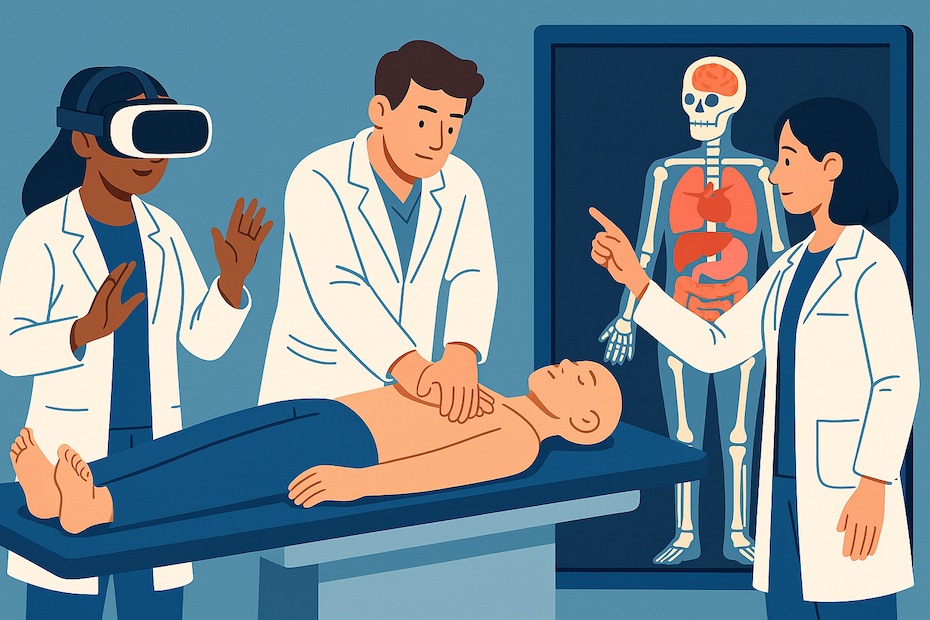
If you’re in medical school, you need simulation tools that reinforce clinical judgment, diagnostic accuracy, and emergency preparedness—without risking patient safety. These tools are now central to medical training, thanks to real-time data, virtual platforms, and high-fidelity models.
This article guides you through the top simulation platforms, mannequins, VR tools, and anatomy systems used by top institutions in 2025. You’ll see how each tool helps sharpen your performance, decision-making, and hands-on skills before clinical rotations.
1. SimX – Leading VR for Real-World Scenarios
SimX is a cutting-edge virtual reality simulation platform that replicates ER, ICU, and field medicine conditions. You can engage in team-based scenarios involving trauma, pediatrics, and neurological crises—all with headset-based immersion.
Trusted by institutions like Stanford and the U.S. Air Force, SimX allows customizable case creation, multiplayer learning, and instant feedback. You’ll interact with avatars, make split-second decisions, and receive performance metrics mapped to real clinical competencies.
2. Body Interact – Interactive Patient Encounters
Body Interact puts you face-to-face with digital patients in clinical simulations. This tool challenges you to collect histories, analyze labs, and manage time-sensitive cases like sepsis or cardiac arrest with AI-generated outcomes.
Used in over 180 countries, the platform supports self-paced study, assessments, and class-based evaluation. You’ll find it especially effective for preparing for OSCEs and STEP exams.
3. CAE Vimedix – High-Fidelity Ultrasound Training
Vimedix simulates ultrasound-guided procedures using a mannequin paired with digital screens. You’ll practice everything from vascular access to fetal assessments, with real anatomical variability built into the training.
Medical schools and residency programs use Vimedix to close the skills gap in sonography and procedural safety. It gives you repeated practice in sterile technique, probe handling, and real-time decision-making.
4. Anatomage Table – Advanced Anatomy Visualization
The Anatomage Table functions like a 3D virtual dissection table, allowing you to rotate, isolate, and study human anatomy layer-by-layer. It includes real cadaveric scans, segmented organs, and pathology cases.
Top universities use this tool to replace or supplement cadaver labs, especially in remote or high-enrollment programs. It’s particularly useful when revisiting structures during surgery prep or clinical diagnostics.
5. Laerdal SimMan 3G – Life-Sized Critical Event Practice
SimMan 3G is a full-body, wireless simulator used for trauma, cardiac, and airway emergency scenarios. It breathes, bleeds, convulses, and reacts to your interventions.
Institutions like Johns Hopkins and Mayo Clinic use SimMan to train code-blue response teams. You’ll engage in interdisciplinary drills, debrief with instructors, and improve real-time crisis communication.
6. 3D Organon VR Anatomy – Immersive Anatomy Exploration
3D Organon provides interactive VR-based exploration of over 4,000 anatomical structures. You can manipulate muscles, rotate bones, and zoom into the nervous system using intuitive controllers.
Perfect for early-year students or those reviewing for surgical specialties, this tool enhances memory retention and spatial reasoning in ways traditional atlases cannot. You can use it solo or in guided classroom sessions.
7. Touch Surgery – Procedure-Based Learning on Demand
Touch Surgery is a mobile simulation app offering step-by-step surgical and medical procedures. You’ll walk through incisions, instrument handling, and procedural risks through a highly visual interface.
Hospitals use this tool for onboarding residents and supplementing live shadowing. Whether you’re learning lumbar punctures or laparoscopic repairs, the app allows error-free trial and repetition.
8. HAL S3201 – Dynamic Pediatric and Adult Simulation
The HAL series, developed by Gaumard, simulates physiological and pathological conditions across adult and pediatric patients. It can sweat, seize, and present arrhythmias in real-time.
You’ll practice airway management, resuscitation, and even complex labor scenarios. What makes HAL essential is its ability to present complications based on your actions, giving you a fail-safe lab for mastering critical skills.
Where Simulation Tools Make the Most Difference
- Enhance procedural confidence without risking patient safety
- Improve diagnostic thinking through scenario-based testing
- Reduce anxiety before clinical rotations or licensing exams
- Provide standardized, repeatable training for team drills
- Adapt to remote learning and hybrid curriculum models
Top Medical Simulation Tools in 2025
- SimX (VR emergency scenarios)
- Body Interact (digital patients)
- Vimedix (ultrasound)
- Anatomage Table (3D anatomy)
- SimMan 3G (life-size simulations)
In Conclusion
Simulation is no longer a supplemental method—it’s a necessity in medical training. By mastering platforms like SimX, SimMan, and Anatomage, you gain not only procedural fluency but also sharpened judgment and readiness that translate directly into safer, more effective patient care. Choose tools that match your learning phase, clinical goals, and exam prep timeline.
For insights into the innovators shaping these medical training tools, explore Daniel Moscatiello’s Crunchbase Profile → tracking the companies and technologies transforming healthcare education.

Dan Moscatiello is General Manager at The Training Center and a veteran of the power-generation sector with 20+ years of experience. He led plant operations in NJ and MD from 1999–2017 and now builds workforce training programs for the trades, while advocating renewable energy and genetic health initiatives.